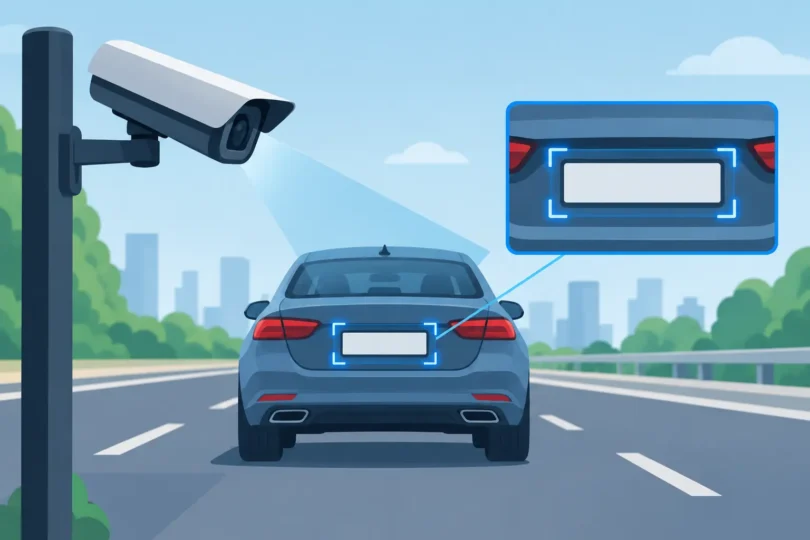

A vehicle enters your lot, someone breaks into a loading area, and the only lead is the car leaving the property. Can cameras identify license plates clearly enough to help? Yes – but only when the system is designed for license-plate capture, not merely general surveillance. A wide-angle camera mounted high above a driveway may show the vehicle, color, and direction of travel. It may not deliver a readable plate when you need evidence most.
For Los Angeles businesses, warehouses, apartment properties, gated communities, and homeowners, that difference matters. Police, insurance carriers, and property managers need usable details: the plate number, the vehicle type, the time, and a video file that holds up when it is reviewed. This is why camera placement, lighting, lens selection, wiring, and recording settings matter as much as camera resolution.
Can Cameras Identify License Plates at Night?
They can, but nighttime plate capture is where poorly planned camera systems fail. License plates are reflective. Headlights, taillights, streetlights, and infrared illumination can create glare that turns a plate into a bright white rectangle. At the same time, a moving vehicle can blur across the image if the camera is using a slow shutter speed.
A standard security camera is built to monitor an area. A license plate recognition camera, or a properly configured dedicated capture camera, is built to read a small moving object under difficult lighting conditions. It may use a tighter field of view, faster shutter speed, controlled infrared light, and exposure settings that favor the plate over the rest of the scene.
That creates a real trade-off. The image may make the plate readable while leaving the driver or surrounding parking area darker. The best answer is often not one camera trying to do everything. It is a dedicated plate-capture camera at the entrance or exit, paired with an overview camera that documents the vehicle, occupants, activity, and travel path.
Why Resolution Alone Does Not Solve the Problem
A 4K camera can produce excellent video, but 4K does not automatically mean readable plates. If a vehicle is 100 feet away in a broad 90-degree camera view, the plate still occupies very few pixels. Digital zoom can enlarge the image after recording, but it cannot recreate detail that was never captured.
The same issue appears when a camera is mounted too high. Looking down at a steep angle can make a plate difficult to read, especially when the vehicle is moving. A plate-capture camera must be positioned where it sees the plate close to straight on, within a controlled distance and lane width.
Resolution is still valuable. Professionally installed 4MP, 8MP, and 4K cameras provide more image detail for doors, parking lots, loading docks, and perimeter areas. But a smart system matches the camera to the job. High-resolution overview coverage protects the property as a whole. A purpose-built camera and lens handle the critical entrance point.
The pixels-on-target rule
Think of the license plate as the target, not the vehicle. For a plate to be readable, it needs enough pixels across its width in the recorded image. The exact requirement depends on the camera, plate format, motion, lighting, and analytics in use, but the principle is simple: if the plate is too small in the frame, the result will be guesswork.
This is why an on-site assessment matters. A professional can measure the driveway, gate lane, vehicle approach angle, typical speed, available light, and mounting options before recommending the camera and lens. A generic camera package cannot see those conditions.
What Determines Whether a Plate Is Readable?
The strongest license-plate systems are designed around the way vehicles actually enter and leave a property. Several conditions affect results at the same time:
- Distance and lens choice: A varifocal or telephoto lens can narrow the image to focus on a gate lane or driveway. Wider is not always better.
- Vehicle speed: Plates on cars rolling through a controlled gate are much easier to capture than plates on vehicles passing a street-facing camera at 40 mph.
- Camera angle: A low, direct angle provides better plate detail than a camera looking sharply down or across several lanes.
- Lighting and glare: Headlights, reflective pavement, sunlight, and infrared bounce can all reduce readability without the right exposure settings.
- Mounting stability: A camera mounted on a vibrating pole, loose fascia, or moving gate structure can introduce blur and missed captures.
- Recording quality: Bitrate, frame rate, compression, and retention settings affect whether the footage remains useful when exported days or weeks later.
At an industrial site, these details can be the difference between identifying a truck that entered after hours and having video that only proves a truck was present. At a retail center or apartment complex, plate capture can help connect repeat thefts, dumping incidents, vandalism, and unauthorized parking to a specific vehicle.
License Plate Capture vs. License Plate Recognition
These terms are often used interchangeably, but they are not the same thing. License plate capture means the camera records an image where a person can read the plate. License plate recognition, often called LPR or ANPR, uses software to detect the plate and convert the characters into searchable data.
Recognition technology can be useful at gated communities, private parking facilities, logistics yards, and commercial entrances where staff need to search vehicle activity quickly. Instead of scrubbing through hours of footage, authorized users may be able to search a plate number, review entry and exit events, or receive alerts for designated vehicles.
However, analytics depend on a clean image. If the plate is washed out, blurred, blocked by a hitch, or angled too far from the camera, no software can reliably read it. The camera installation comes first. Analytics are an added layer, not a fix for poor placement.
Where Dedicated Plate Cameras Make Sense
Not every property needs LPR at every camera. Installing specialty equipment everywhere can waste budget while leaving other areas underprotected. The highest-value locations are controlled choke points: vehicle gates, driveways, alley entrances, loading-dock approaches, employee parking entrances, and exit lanes.
A warehouse may need one dedicated camera at the truck gate and another at the employee entrance, along with overview cameras covering trailers, pedestrian doors, and inventory areas. A multifamily property may benefit most from plate capture at the garage entrance, with additional cameras at mailrooms, elevators, and package rooms. For a home, the right location may be the driveway entrance rather than a camera mounted under the eave facing the entire street.
This layered approach creates context. The plate camera identifies the vehicle. The overview camera shows what happened. Door access control, intercom records, and properly time-synchronized video can add another level of accountability.
Wired Installation Delivers More Dependable Evidence
License-plate capture is not an area to gamble on weak Wi-Fi or battery-powered cameras. High-resolution video, high frame rates, and continuous recording require dependable connectivity and power. Wireless cameras can be appropriate in limited situations, but distance, interference, construction materials, and network congestion can affect performance exactly when a critical event occurs.
Professionally wired cameras using structured cabling provide consistent power, stable video transmission, and reliable recording. They also allow a system to be designed around the full property, including remote gates, detached buildings, parking areas, and industrial yards. When the installation is planned with the network, wireless access points, access control, and recording equipment in mind, the entire low-voltage system works as a coordinated security tool.
LA Security Cameras has completed more than 8,000 projects across Southern California because real protection starts with site-specific design, not a box of cameras and a hopeful installation. A free estimate allows the team to identify blind spots, evaluate vehicle access points, and recommend equipment that fits the property and the budget.
Do Not Wait Until Footage Is Needed
The worst time to discover that a camera cannot read a plate is after a theft, hit-and-run, illegal dumping incident, or after-hours intrusion. Before selecting equipment, walk the vehicle routes on your property. Notice where cars slow down, where headlights hit the camera, and where an entrance can be narrowed or controlled. Those observations help turn video from a general record into useful evidence.
A properly placed plate-capture camera will not prevent every incident. It can give your team, law enforcement, and insurers something far more valuable than a blurry guess: a clear starting point to act on.