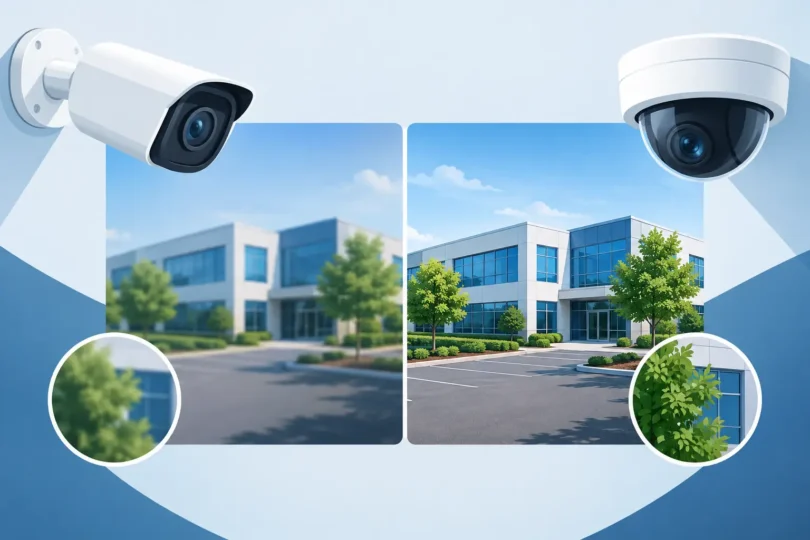

A camera labeled 4K and a camera labeled 8MP are often treated as two different classes of equipment. In many cases, that is not true. When comparing 4K versus 8MP surveillance cameras, the key fact is that both terms commonly describe the same resolution: roughly 8 million pixels. The real decision is not the label on the box. It is whether the camera, lens, lighting, wiring, recorder, and placement can deliver useful evidence at your property.
For a Los Angeles storefront, warehouse, apartment building, construction yard, or home, buying resolution alone will not eliminate blind spots or identify a suspect after dark. A professionally designed system will.
Are 4K and 8MP Surveillance Cameras the Same?
Usually, yes. An 8MP camera typically produces an image measuring 3840 by 2160 pixels. That is the same pixel count associated with consumer 4K UHD video. Multiply those dimensions together and you get approximately 8.3 million pixels.
Manufacturers tend to use the terms differently. Some market the camera as 4K because buyers recognize the term from televisions and monitors. Others use 8MP because megapixels make it easier to compare a camera with 2MP, 4MP, or 12MP models. Neither term automatically means one camera is clearer, more reliable, or better for identifying faces and license plates.
There is a small technical distinction worth knowing. True cinema 4K is wider than UHD, at 4096 by 2160 pixels. Most security cameras described as 4K use the 3840 by 2160 UHD standard. For surveillance planning, this difference rarely affects the buying decision. What matters is how the camera performs at the distance and under the lighting conditions where an incident is likely to happen.
Why Two 8MP Cameras Can Produce Very Different Evidence
Resolution is only one part of image quality. A low-cost 8MP camera pointed across a dark parking lot may create a wide image full of motion blur, glare, and digital noise. A well-selected 8MP camera with the right lens, sensor, infrared support, and recording settings can capture a far more useful image in the same area.
Sensor size and low-light performance
More pixels do not automatically mean better nighttime video. Small pixels on a small sensor can struggle in low light. The camera may compensate by increasing gain, slowing shutter speed, or applying heavy noise reduction. The result can look bright enough to watch, yet be too soft to identify a person who is moving quickly.
This matters around loading docks, side gates, alleys, rear entrances, and parking areas. These are common weak points because lighting is uneven and criminal activity often happens after business hours. For these locations, a camera must be evaluated for low-light performance, not just daytime resolution.
Lens selection determines useful coverage
An 8MP camera mounted high on a building can cover a large area. That does not mean it can identify everyone in that area. When the field of view is too wide, people and vehicles occupy too few pixels for dependable identification.
A fixed wide-angle camera may be excellent for documenting activity across a lobby, sales floor, driveway, or warehouse aisle. A tighter lens may be necessary at a gate, cash register, employee entrance, or vehicle access point. In many properties, the strongest design uses both: overview cameras to show what happened and targeted cameras to show who did it.
Frame rate and shutter settings affect motion
A high-resolution camera recording at a low frame rate may miss critical moments during fast movement. Slow shutter settings can also blur faces, hands, or license plates. This is particularly relevant for vehicle entrances, busy commercial driveways, and areas where theft suspects may run through the scene.
Higher frame rates and faster shutter speeds demand more light, bandwidth, and storage. That is a trade-off, not a reason to avoid them. The right settings depend on the threat. A quiet storage room does not need the same configuration as a gate where vehicles enter at speed.
When 4K or 8MP Cameras Make Sense
4K and 8MP cameras are strong choices when you need a broad view while preserving the ability to digitally zoom into a portion of recorded footage. They work especially well for open areas where a lower-resolution camera would force you to choose between wide coverage and useful detail.
They are often a practical fit for warehouse interiors, retail floors, parking lots, apartment common areas, large residential driveways, equipment yards, and perimeter approaches. On an industrial site, an 8MP camera can help document movement around valuable inventory, trailers, tools, and access points.
However, 8MP is not automatically the right answer for every location. A 4MP camera can be the smarter choice in a narrow hallway, interior office, elevator, or small entryway where the field of view is limited and low-light performance is the priority. A lower-resolution camera may also reduce storage requirements while still producing excellent identification at the intended distance.
The best surveillance systems are not built by placing the highest-megapixel camera everywhere. They are built by matching each camera to its job.
The Hidden Cost: Bandwidth and Storage
An 8MP camera sends significantly more image data than a 2MP or 4MP camera. Multiply that demand across 16, 32, or more cameras, and the network and recorder must be designed to handle it. Poor planning can lead to dropped frames, recording gaps, overloaded switches, or reduced image quality caused by aggressive compression.
A professionally wired network is the dependable foundation for high-resolution surveillance. Wireless cameras can be convenient for limited residential applications, but commercial and industrial properties need stable connections, predictable bandwidth, and reliable power. Cabling also lets installers position cameras where they need to be, rather than where a Wi-Fi signal happens to reach.
Storage should be planned around the number of cameras, resolution, frame rate, motion activity, compression settings, and required retention period. A warehouse with constant forklift traffic generates much more recorded data than a quiet office after hours. If your insurance requirements, internal policies, or investigation needs call for 30 days of footage, the recorder must be sized for the real workload.
Camera Placement Matters More Than Marketing Terms
Security failures often begin with camera placement. A camera mounted too high may show the top of a hat instead of a face. A camera aimed directly at headlights may lose vehicle details to glare. A camera at a gate may see a license plate during the day but fail at night because infrared reflection washes out the image.
Before selecting equipment, assess the property from the perspective of someone trying to avoid detection. Look at rear doors, roof access, side alleys, delivery areas, employee entrances, cash-handling zones, vulnerable windows, perimeter fences, and spots where vehicles can approach or leave quickly.
For facial identification, the camera needs an appropriate angle, distance, and field of view. For license plates, it needs settings and positioning designed for vehicles. One general-purpose camera rarely performs both jobs perfectly. This is why a site consultation matters. A camera system should respond to real traffic patterns and real risks, not a generic floor plan.
How to Choose Between 4MP and 8MP Cameras
Start with the question that matters most: what evidence do you need if an incident occurs? If you need to see general activity in a contained area, 4MP may be enough. If you need broader coverage and the ability to inspect details in recorded footage, 8MP or 4K may be the better investment.
Then consider lighting, mounting height, subject distance, expected movement, retention requirements, and available network infrastructure. A property with poor exterior lighting may benefit more from better lighting and a camera optimized for low light than from a higher resolution rating. A large facility may need upgraded switches, structured cabling, and a properly sized NVR before adding a fleet of 8MP cameras.
LA Security Cameras has completed over 8,000 projects throughout Southern California because effective security starts with a practical plan. With over 500 FIVE-star reviews, our team understands that customers do not need more technical jargon. They need clear footage, fewer blind spots, dependable recording, and a local installer who will stand behind the work.
If you are deciding between 4K, 8MP, and 4MP cameras, request a free estimate before purchasing equipment. A site-specific recommendation can protect your budget while making sure the video you record is the video you can actually use when it matters.