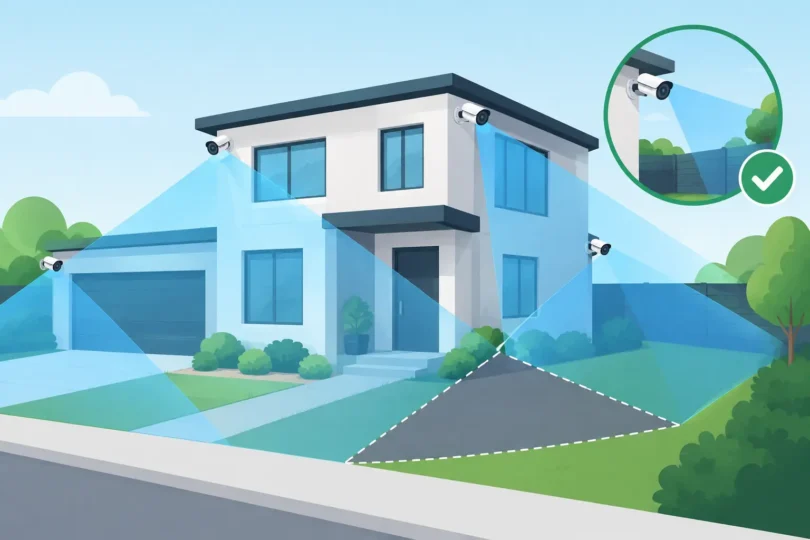

A camera can be powered on, recording, and still fail at the one moment you need it most. A gate left just outside the frame, a dark loading area, a side door blocked by a parked truck, or a face washed out by direct sunlight can leave a property exposed. To prevent security camera blind spots, you need more than cameras mounted at convenient corners. You need a coverage plan built around how people actually enter, move through, and target your property.
For Los Angeles businesses, warehouses, apartment properties, construction sites, and homes, blind spots are not a minor technical issue. They can mean missing evidence after theft, vandalism, unauthorized entry, employee disputes, or a liability claim. A professionally designed system gives you useful video when it matters, not just a collection of camera icons on a phone app.
Start With the Property, Not the Camera
The biggest placement mistake is choosing camera locations before identifying the risks. A camera facing a front entrance may look like coverage, but it does little for a rear delivery door, dumpster enclosure, alley, parking area, roof access point, or the path between buildings.
A proper site assessment begins with the perimeter and works inward. Identify every vehicle entrance, pedestrian entrance, emergency exit, roll-up door, side gate, hallway intersection, cash-handling area, inventory zone, server room, and common area. Then consider the routes a person would use to approach or leave without being seen.
This is especially important on commercial and industrial properties. Warehouses often have high shelving, loading docks, forklifts, trailers, and stacked inventory that change sightlines throughout the day. Multi-tenant buildings may have shared corridors and parking areas where responsibility is unclear. Homes may have side yards, detached garages, pool gates, and street-facing driveways that a basic doorbell camera cannot adequately cover.
The right design depends on the property. More cameras are not always the answer. Strategic coverage with the right lens, mounting height, resolution, and lighting often delivers better evidence than several poorly placed cameras.
Use Overlapping Views to Prevent Security Camera Blind Spots
Every critical area should have more than one useful angle whenever practical. This is called overlapping coverage, and it is one of the strongest ways to prevent security camera blind spots caused by obstructions, tampering, weather, or changing activity on site.
For example, one camera may provide a wide overview of a parking lot while another captures a tighter view of vehicles entering through the gate. The overview establishes what happened and where people moved. The tighter camera can capture faces, clothing details, vehicle markings, or license plates when conditions allow.
At a business entrance, a wide-angle camera should not be your only view. Wide lenses cover more area, but people farther from the camera appear smaller. A second camera positioned to capture faces at a controlled distance gives police, management, or insurance investigators far more usable footage.
Overlap also protects against camera interference. If someone sprays paint on, moves, or damages one camera, another camera may still record the approach and the incident. That is a major advantage over isolated cameras aimed at a single doorway.
Watch Corners, Elevation, and Obstructions
Corner-mounted cameras are common, but they are not automatically effective. A camera mounted too high can show the top of a person’s head instead of their face. A camera mounted too low may be easy to reach and tamper with. The correct height depends on the target area, camera type, and whether the goal is general observation, facial identification, or vehicle documentation.
Trees grow. Delivery trucks park. Signage goes up. Exterior lighting changes. Inside, pallets, racks, displays, and partitions can block a camera that initially had a clear view. Review camera footage after installation from the perspective of an actual incident. Can you identify a person entering? Can you see where they came from? Can you follow them to the point of loss or damage?
If the answer is no, the system needs adjustment.
Match the Camera and Lens to the Job
A high-resolution camera cannot fix a bad field of view. It can provide more detail, but only if the subject occupies enough of the image and lighting supports a clean picture.
A 4MP camera may be an excellent choice for many entrances, offices, hallways, and residential areas. An 8MP or 4K camera can provide added detail across larger scenes, such as parking lots, warehouses, and wide exterior areas. But 4K video requires more storage, network capacity, and careful setup. It is not a magic solution for every camera location.
Lens selection matters just as much. A wide lens is useful for monitoring broad spaces, while a narrower lens is better for a long driveway, gate lane, loading dock, or other specific target area. Varifocal cameras allow the installer to adjust the field of view during setup, which is valuable when a camera must capture a precise door, vehicle lane, or aisle.
PTZ cameras can be useful for active monitoring of large properties, but they should not replace fixed cameras at critical points. A PTZ camera can only look in one direction at a time. If it is tracking activity on one side of the property, another event may occur outside its current view. Fixed cameras create consistent, reliable evidence.
Plan for Darkness, Glare, and Real Los Angeles Conditions
A daytime image can create false confidence. The real test is what happens after dark, when glare from headlights, security lights, storefront glass, or nearby traffic can reduce image quality.
Infrared night vision helps cameras see in low light, but it has limits. Reflective surfaces, tinted windows, dust, rain, fog, and objects close to the lens can cause infrared glare. A camera looking through a window at night is another common problem because the infrared light reflects off the glass and blinds the camera.
Good exterior lighting can improve facial recognition and color detail, but lighting must be positioned correctly. A bright fixture directly behind a person can turn them into a silhouette. Cameras should be tested at night with real vehicle headlights, door lights, and movement through the scene.
Parking lots and driveways deserve special attention. A camera that sees a vehicle is not necessarily a camera that captures a readable plate. Plate capture requires the right camera angle, focal length, shutter settings, lighting, and distance. For properties that depend on vehicle identification, a dedicated license plate capture solution is often the practical choice.
Do Not Let Wi-Fi Create a Coverage Failure
Wireless cameras may be convenient for limited residential use, but Wi-Fi coverage gaps can become surveillance gaps. Thick walls, metal racks, concrete, neighboring networks, distance, and electrical interference can cause dropped video, delayed notifications, or inconsistent recording.
Commercial facilities should be especially cautious about depending on consumer wireless cameras. A warehouse, apartment complex, retail store, or industrial yard may need professionally installed network cabling, properly placed wireless access points, and a recording system sized for the number of cameras and required retention period.
Professionally wired camera systems provide stable connections and consistent power through Power over Ethernet. They also allow cameras to be installed where coverage is needed, not only where the Wi-Fi signal happens to be strongest. That distinction matters when your system is expected to document a break-in, workplace incident, or after-hours delivery.
Check the Recording System Before an Incident Does
Blind spots are not always physical. A camera may have a clear view but fail to record because storage is full, motion settings are poorly configured, the recorder is offline, or the network has been interrupted.
Set recording schedules based on the risk. Continuous recording is often the best choice for high-priority exterior areas, entrances, cash rooms, and active warehouse zones. Motion-based recording can conserve storage in lower-risk areas, but it must be tested carefully. Fast-moving people, shadows, insects, rain, and poor motion zones can cause missed clips or excessive alerts.
Retention time matters too. Many property owners discover an incident days later, after footage has already been overwritten. The number of cameras, resolution, frame rate, recording method, and storage capacity all affect how long video remains available. There is no one-size-fits-all retention period, but the system should be sized around your operational reality and investigation timeline.
Get a Professional Coverage Review
A camera system should be designed as part of the property’s complete security infrastructure. Cameras work better when coordinated with access control, gate systems, intercoms, alarm components, structured cabling, and reliable network coverage. When these systems are installed separately without a plan, gaps are more likely to appear.
LA Security Cameras has completed over 8,000 projects across Southern California and understands the conditions that generic camera packages miss. A hands-on site review can identify weak angles, poor night visibility, network limitations, and areas where a camera upgrade or repositioning would make a real difference.
Do not wait for theft, damage, or a dispute to reveal what your cameras missed. Request a free estimate, walk the property with an experienced installer, and make sure every camera is positioned to protect the people, assets, and operations that depend on you.