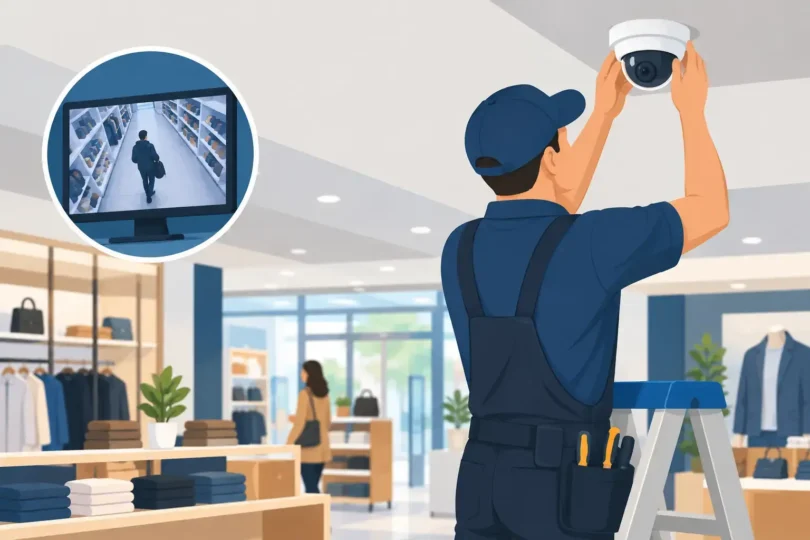

A thief does not need much time. In many retail theft cases, the critical moment happens in seconds: merchandise goes into a bag, a person walks through an unobserved aisle, or a vehicle leaves before anyone can read the plate. This retail theft camera installation example shows how a professionally designed system can give a Los Angeles store owner usable visibility before, during, and after an incident.
The goal is not to hang cameras in every corner and hope for the best. The goal is to capture faces, transactions, product movement, exits, and vehicle activity with footage that can actually support a police report, an internal investigation, or a loss-prevention decision. That requires strategic placement, the right resolution, dependable wiring, and recording that does not fail when the store needs it most.
Retail Theft Camera Installation Example: A Typical Store
Consider a 3,500-square-foot neighborhood retail store in Southern California. It has a front entrance, two checkout lanes, six merchandise aisles, a small stockroom, a rear delivery door, and a parking lot shared with nearby businesses. The owner has experienced walkouts, suspicious refund activity, after-hours loitering, and repeat shoplifting near high-value products.
A basic consumer camera package might show that someone was in the building. That is not enough. A professional installation should be designed to answer the questions that matter: Who entered? What did they take? Did an employee follow procedure? Which direction did the suspect leave? What vehicle was involved?
For this type of property, a practical system may include 10 to 14 professionally wired cameras connected to a network video recorder. The final count depends on ceiling height, aisle layout, the amount of glass at the storefront, lighting conditions, and whether the parking lot is under the store owner’s control. More cameras are not automatically better. Proper coverage is better.
Front entrance and customer flow
The entrance needs more than a wide view of people walking in. A camera positioned too high or too far back may record only the top of hats and hoodies. In this example, a 4K camera is aimed at the entrance approach to capture a clear facial image as customers enter, while another camera covers the exit path and the immediate sidewalk area.
Placement is adjusted for bright sunlight, reflective glass, and nighttime lighting. Los Angeles storefronts often face harsh afternoon glare, which can turn a suspect’s face into a dark silhouette if the camera is aimed incorrectly. Professional installers account for that condition during the site assessment instead of discovering it after a theft.
Checkout lanes and employee accountability
Each point of sale receives dedicated coverage. The camera angle should show the cashier, the customer, the counter surface, and the handoff area without making the register screen unreadable or creating unnecessary privacy concerns.
This is where camera systems protect honest employees too. Clear video can help resolve disputes involving returns, cash shortages, voids, discounts, or accusations that a cashier ignored a theft. A wide overhead camera alone usually cannot show the details of a transaction. A properly positioned 4MP, 8MP, or 4K camera gives management a much stronger record of what occurred.
High-theft aisles and merchandise displays
The store’s most frequently targeted products should not sit in camera shadows. In this example, cameras are installed to look down the high-theft aisles from opposing angles. One view tracks the aisle itself, while the second view captures a person’s face as they move toward or away from the display.
That two-angle approach matters. A single aisle camera may capture the act but miss the face. Another camera may capture the face but not show the product being concealed. Together, the views establish a usable sequence of events.
Small, inexpensive cameras mounted randomly across the ceiling frequently produce a common failure: a large amount of video with very little identifying detail. Resolution matters, but angle, distance, lens selection, lighting, and camera height matter just as much.
Stockroom, rear door, and delivery access
Retail theft is not always a front-door problem. Stockrooms, receiving areas, rear exits, and trash enclosures can become weak points for unauthorized removal of inventory. In this installation example, cameras cover the stockroom entrance, inventory shelving, the rear door from inside and outside, and the loading area.
The rear exterior camera is positioned to document people, vehicles, and activity around the door without being blocked by delivery trucks. If the location has poor lighting, infrared performance and supplemental exterior lighting should be evaluated together. A camera cannot create identifying color detail out of a completely dark scene.
Parking Lot Coverage Is About Evidence, Not Just Motion Alerts
When a theft suspect leaves the store, the parking lot can provide the evidence that connects the incident to a vehicle. A general overview camera helps show direction of travel and activity around the property. A separate, carefully aimed camera may be needed to capture license plates at a driveway or vehicle exit.
License-plate capture is not the same as a standard parking lot view. The camera must be placed at the correct height and angle, with settings matched to vehicle speed, headlights, distance, and nighttime conditions. If the target area is too wide, a 4K image can still leave the plate too small to read.
For a shared lot, coverage also has limits. The business should focus cameras on its storefront, entrances, designated parking areas, and access routes. A professional consultation helps define what is realistic without creating false expectations about coverage across a large commercial center.
Why Wired Recording Is the Decisive Choice
Retail surveillance depends on consistent recording. Wi-Fi cameras can be useful in limited situations, but a busy store with metal shelving, refrigeration equipment, neighboring networks, and multiple wireless devices is not the place to gamble with a signal. Dropped connections, weak coverage, and bandwidth limitations can create gaps at exactly the wrong time.
A professionally wired camera system uses structured cabling to connect cameras back to the recorder and network equipment. This supports stable video transmission, centralized management, and reliable recording. The recorder should be sized for the number of cameras, their resolution, frame rate, motion settings, and the number of days the business wants to retain footage.
Retention is a business decision. A small store may need 14 to 30 days, while a higher-risk operation may require longer retention. High-resolution footage uses more storage, so there is a trade-off between image quality, camera count, continuous recording, and retention time. The answer should be calculated, not guessed.
Build the System Around Real Operations
The strongest retail camera system works with the rest of the property. Door access control can document who enters employee-only areas. A GSM entry system or intercom can manage deliveries. Wireless access points can improve network coverage where staff devices and point-of-sale equipment need dependable connectivity. Properly organized low-voltage cabling keeps these systems easier to service as the business grows.
Camera placement should also respect employee and customer privacy. Do not install cameras in restrooms, changing areas, or any location where privacy is reasonably expected. Audio recording rules can be more restrictive than video rules, so businesses should discuss whether audio is necessary before enabling it.
The final step is testing. Every camera should be reviewed during day and night conditions. The owner or manager should know how to search by time, export a video clip, and preserve footage after an incident. A system that records excellent video is still not enough if no one can retrieve the evidence quickly.
LA Security Cameras has completed over 8,000 projects across Southern California because effective protection starts with the property, not a generic camera bundle. A free estimate gives store owners a chance to identify blind spots, evaluate 4MP, 8MP, and 4K options, and build a professionally wired system around the way their business actually operates.
Retail theft cannot always be prevented, but a thief should never be able to exploit a blind spot, a weak signal, or unusable footage. The right installation turns a vulnerable store into a property that is watched, documented, and ready to respond.