
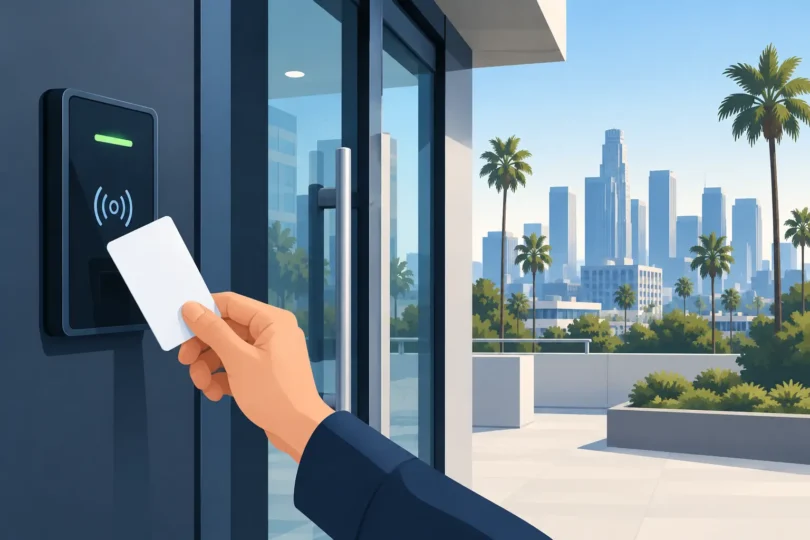

A front-door key can be copied in minutes, passed from a former employee to a friend, or disappear without anyone knowing which lock is now exposed. Access control replaces that uncertainty with accountability: who entered, which door they used, and when it happened. For Los Angeles businesses, apartment properties, warehouses, and homes, that record can be the difference between a preventable incident and an expensive investigation.
A professionally designed system does more than unlock a door with a card, fob, code, or phone. It establishes rules around the property. Employees can enter only the areas required for their roles. Vendors can receive temporary credentials. Former staff can be removed immediately without collecting every physical key. Property owners gain a practical way to protect people, inventory, equipment, and restricted spaces.
Why Physical Keys Create Expensive Gaps
Traditional locks still have a place on certain doors, but keys are difficult to manage at scale. A manager may not know how many copies exist. Rekeying after turnover, a lost master key, or a tenant move-out costs money and disrupts operations. Worse, it provides no history. If someone enters a storage room at 2:00 a.m., a key cannot tell you who opened the door.
That gap is especially serious at facilities with high-value materials, sensitive records, medications, tools, cash handling, server rooms, or multiple shifts. Warehouses and industrial sites also face a common challenge: many entry points, changing crews, and loading areas that must remain operational while security stays controlled.
Access systems create an audit trail. A manager can review credential activity after a theft, investigate a disputed entry, or confirm when a contractor arrived. When paired with properly placed surveillance cameras, an entry event can be matched to clear video of the person at the door. This is the level of documentation that helps management make decisions and gives law enforcement usable evidence when an incident occurs.
Access Control Starts With the Door, Not the Device
The wrong approach is buying a reader first and hoping it fits the door. Every opening has different hardware, traffic patterns, fire-life-safety requirements, and security risks. A busy employee entrance needs something different from a quiet executive office, a rear warehouse door, or a residential pedestrian gate.
A complete system may include a card or mobile reader, electric strike or magnetic lock, request-to-exit device, door position sensor, power supply, backup power, cabling, controller, and management software. The door hardware must be selected carefully. A fail-safe lock releases when power is lost, which is common where safe egress is the priority. A fail-secure lock stays locked during a power outage, which may be appropriate for certain exterior doors. The correct choice depends on the opening and applicable code requirements.
This is why professional installation matters. A reader mounted on the wall is not a security plan if the door can be forced, propped open, bypassed through a weak frame, or left without reliable emergency egress. The entire opening needs to work as one system.
Credentials Should Match How Your Property Operates
Key fobs and access cards remain reliable, familiar choices for many commercial properties. They are easy to issue, deactivate, and replace. PIN codes can work well for smaller teams, but shared codes reduce accountability because several people may use the same number.
Mobile credentials add convenience for staff who already carry a smartphone and for properties that want fewer physical badges to manage. Biometric options may be appropriate for highly restricted areas, but they require careful consideration of privacy expectations, user acceptance, and the operating environment. Dusty industrial settings, gloves, outdoor conditions, and frequent visitors can make a simple fob system the better operational choice.
There is no universal “best” credential. The right answer depends on the people using the system, the level of risk, and how quickly management needs to add or remove access.
What a Strong Access Control Plan Looks Like
A well-designed system separates the property into practical security zones. The goal is not to make daily work difficult. It is to stop unrestricted movement where it creates unnecessary risk.
For a commercial office, that may mean controlled entry at the main door, suite doors, IT room, records storage, and after-hours areas. For an apartment or HOA property, it may include pedestrian gates, parking access, package rooms, pool gates, common-area doors, and management offices. For a warehouse, priorities often include employee entrances, loading docks, tool cages, inventory rooms, and offices containing financial or shipping information.
Permissions should follow responsibilities. A delivery driver does not need access to a server room. A night cleaning crew may need entry to specific spaces during limited hours but not unrestricted access all weekend. Temporary access can be scheduled to expire automatically, removing the need for someone to remember to collect a key.
The most effective plans usually address these four questions:
- Which doors create the highest risk if left uncontrolled?
- Who needs access to each area, and during what hours?
- What happens if power or network service is interrupted?
- How will management review events and respond to an alert?
Those answers turn access control from a gadget into a working security policy.
Pair Door Events With Video Surveillance
Door logs are valuable, but video provides context. A credential may show that an employee badge opened a door. Video can show whether that employee entered alone, held the door open for others, delivered equipment, or encountered an attempted break-in.
Strategic camera coverage should capture the approach to the door, the person using the reader, and the area immediately inside when appropriate. Image quality matters. A distant, poorly lit camera may prove that movement occurred without identifying a face or documenting what happened. For exterior entries, camera placement, lighting, viewing angle, and resolution all affect whether footage is useful after an incident.
For many Southern California properties, a combined system is the practical choice. Door events help pinpoint the exact moment to review. Cameras provide visual verification. Intercoms, GSM entry systems, alarms, structured cabling, and reliable network coverage can extend that protection across the property rather than leaving each technology disconnected.
Wired Infrastructure Is a Security Decision
Wireless devices can be useful in limited situations, but critical access hardware should not depend on a weak signal, consumer-grade equipment, or improvised power arrangements. Professional low-voltage wiring supports dependable communication between readers, controllers, locks, cameras, and network equipment.
Proper cabling also makes service and expansion easier. A property may begin by securing two exterior doors, then add a gate, a storage room, and employee entrances as operations grow. Planning pathways, controller capacity, network connections, and power from the start can prevent expensive rework later.
Reliability matters most when something goes wrong. Power failures, internet interruptions, forced-door events, and attempted tampering are exactly when a poorly planned system reveals its weaknesses. Backup power, secure controller placement, protected cabling, and clear override procedures should be part of the design conversation.
Avoid the Most Common Access Control Mistakes
Many properties install access control after a break-in, employee theft, or unauthorized entry. The urgency is understandable, but rushed decisions can create another problem: a system that is difficult to manage or does not secure the real vulnerabilities.
Do not control only the front door while leaving rear exits, side gates, roof access, or interior restricted rooms unaddressed. Do not issue shared credentials when individual accountability is needed. Do not assume an app alone makes a property secure. And do not overlook doors that are routinely propped open because employees lack a convenient, workable entry process.
Management also needs ownership of the system. Someone should be responsible for promptly removing departed employees, reviewing unusual events, updating schedules, and maintaining an accurate credential list. Technology supports accountability, but it cannot replace it.
Get a System Built for Your Actual Property
Every property has different entry patterns, construction conditions, and exposure points. A small retail store may need controlled rear access and a clear camera view of the cash office. A large industrial facility may require multiple reader-controlled doors, gate access, network upgrades, and surveillance coverage that follows goods from loading dock to storage area.
LA Security Cameras has completed over 8,000 projects across Southern California and understands that security systems must perform in real conditions, not just look good in a product brochure. A site assessment can identify weak doors, blind spots, infrastructure limitations, and the most cost-effective way to build in phases.
The right access control system should make authorized entry simple and unauthorized entry difficult. Start with the doors that matter most, build on dependable wired infrastructure, and create a record you can rely on when the stakes are high.