
A warehouse can lose thousands of dollars in a few minutes – and the one camera aimed at the loading dock may not show who entered, which pallet moved, or where a box disappeared. Warehouse camera coverage is not about putting cameras on every wall. It is about creating clear, usable visibility from the front gate to the farthest storage aisle, with footage that can identify people, document activity, and support a real investigation.
For Southern California warehouses, distribution centers, contractor yards, and industrial properties, generic camera kits are rarely enough. High ceilings, moving forklifts, stacked inventory, changing layouts, poor exterior lighting, and wide vehicle entrances all create blind spots. A professional camera plan accounts for those conditions before installation starts.
Why Warehouse Camera Coverage Is a Business Issue
A gap in coverage can become a loss-prevention problem, a safety problem, or an evidence problem. When merchandise goes missing, a manager needs more than a wide shot of an aisle. They need a clear sequence of events: who entered, what was removed, where it went, and whether it left through a dock door, employee exit, or vehicle gate.
The same visibility matters after employee injuries, delivery disputes, vandalism, break-ins, and unauthorized access. A camera system that records a blurry figure 80 feet away may confirm that something happened. It may not provide the facial detail, license plate information, or timeline needed to act on it.
Good coverage also improves day-to-day accountability. Warehouse operators can review dock activity, verify shipments, investigate damaged inventory, and resolve disagreements without relying on memory or conflicting statements. The goal is not to watch every employee minute by minute. The goal is to protect people, inventory, equipment, and operations with documented facts.
Start With the Areas That Create the Most Exposure
Every property has a different flow of people and goods, but the highest-risk locations are usually predictable. The perimeter, entry points, loading areas, and inventory movement zones deserve priority before break rooms, offices, or low-value spaces.
Cover the Perimeter Before an Intruder Reaches the Building
Exterior cameras should document approaches to the facility, including vehicle gates, pedestrian gates, parking areas, fences, rear access points, and alleyways. A camera facing outward from the building can show activity near the structure, while a camera placed to capture the approach may show where a person or vehicle came from.
This distinction matters. If a thief cuts through a side gate, footage of the final door entry is helpful, but footage showing the vehicle, direction of travel, and possible license plate is far more valuable. For large yards, exterior coverage often requires more than a few fixed cameras. Long drive lanes and distant gates may need dedicated cameras with the right lens and resolution for the distance.
Make Loading Docks and Receiving Areas Non-Negotiable
Loading docks are high-traffic, high-value areas where vendors, drivers, employees, forklifts, and merchandise converge. Cameras should cover the dock doors, the staging area, trailer openings when practical, and the route inventory takes after receiving.
One overhead camera may show that a delivery occurred. It will not always prove whether the correct pallet was unloaded, whether a carton was damaged before it entered the building, or who had access while the dock was open. Multiple angles give managers context. This is especially important when a dock door remains open after hours or when different carriers share the same receiving area.
See Down Aisles, Not Just Across Them
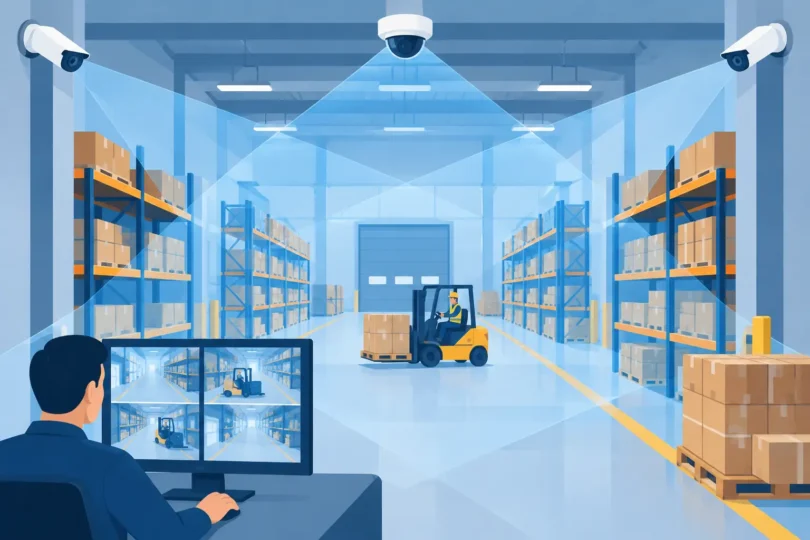
Warehouse aisles create a common coverage failure. Cameras mounted high and aimed across several aisles may provide a broad overview, but rack uprights and stacked pallets can block the view exactly where inventory is stored. The resulting footage often shows the top of a person’s head and very little else.
Aisle cameras should be planned around rack height, aisle length, product placement, and expected activity. In many facilities, cameras aimed down the aisle provide better identification and clearer documentation of picks, transfers, and removals. The correct layout depends on the building, but the principle is simple: test sightlines at the actual height of people and merchandise, not from a drawing alone.
Protect Doors, Offices, and Restricted Rooms
Employee entrances, emergency exits, IT closets, tool cribs, cage storage, shipping offices, and areas containing controlled or high-value inventory need focused coverage. Cameras at doors should capture usable facial detail as a person approaches or exits. A wide camera placed too far away may show the doorway without identifying the person using it.
For restricted areas, surveillance works best alongside access control. When a door system records credential activity and a camera records the entry, managers have a stronger record of who accessed the area and when. That combination can reduce disputes and make investigations faster.
Camera Resolution Alone Does Not Solve Blind Spots
4MP, 8MP, and 4K cameras can produce excellent images, but more pixels do not automatically mean better evidence. Camera height, lens selection, lighting, mounting angle, storage settings, and network performance all affect what the recording actually shows.
A 4K camera can be an excellent choice for a wide receiving area or a large parking lot where digital zoom may be needed later. But a properly positioned 4MP or 8MP camera can outperform a poorly placed 4K camera every time. The question is not, “What is the highest resolution available?” The question is, “What detail do we need at this exact location?”
License plate capture is a good example. A standard overview camera may see a vehicle enter a gate, yet fail to capture the plate because of speed, glare, headlights, angle, or distance. Plate capture often requires a dedicated camera placed and configured for that lane. The same is true for facial identification at exterior doors.
Plan for Lighting, Height, and Real Warehouse Conditions
Warehouses are hard environments for cameras. High-bay lighting can create bright hotspots and deep shadows. Roll-up doors can flood a camera with sunlight. Forklifts can temporarily block a view. Dust, vibration, and heat can affect equipment over time.
Cameras need to be mounted high enough to avoid tampering, but not so high that every face becomes unrecognizable. Exterior cameras need weather-appropriate housings and thoughtful placement to reduce glare. Interior cameras must be positioned around racking, fire sprinkler clearance, equipment paths, and future inventory changes.
Night coverage deserves special attention. Infrared cameras can help in dark areas, but infrared reflects off nearby walls, trailer surfaces, and shiny materials. In some locations, adding proper lighting produces more useful color footage than relying on infrared alone. A site assessment identifies these trade-offs before cameras are installed in the wrong locations.
Wired Systems Deliver More Dependable Recording
Wireless cameras may appear convenient, but warehouses place heavy demands on a security network. Metal racks, concrete walls, refrigeration equipment, industrial machinery, and large open spaces can weaken or disrupt Wi-Fi signals. A dropped connection at the wrong time can mean missing footage.
Professionally wired camera systems provide a more dependable path for video, power, and recording. Structured cabling also makes it easier to scale the system as the operation grows. A warehouse may begin with cameras at docks and entrances, then add coverage for a new storage area, expanded yard, or access-controlled employee entrance. Planning the cable pathways from the beginning prevents expensive patchwork later.
Recording capacity matters just as much as camera placement. Higher-resolution cameras and longer retention periods require more storage. Managers should decide how long footage needs to be retained based on operational needs, incident reporting timelines, and the volume of activity. A system that overwrites critical video after a few days is not providing the protection the facility needs.
A Professional Walkthrough Finds the Coverage Gaps
The fastest way to waste money is to count cameras before studying the property. A real warehouse camera coverage plan starts with a walkthrough: how vehicles arrive, where employees enter, where inventory changes hands, where visibility is blocked, and which incidents would be hardest to investigate.
At LA Security Cameras, that process is built around practical placement, professionally wired infrastructure, and the level of image detail each area requires. With more than 8,000 completed projects and over 500 FIVE-star reviews, the team understands that warehouses do not need generic recommendations. They need cameras designed around real doors, docks, aisles, yards, networks, and risks.
Ask for a free estimate before the next loss, disputed delivery, or after-hours incident forces the issue. The right camera plan gives your team a clearer answer when something happens – and a stronger reason for criminals to choose another property.